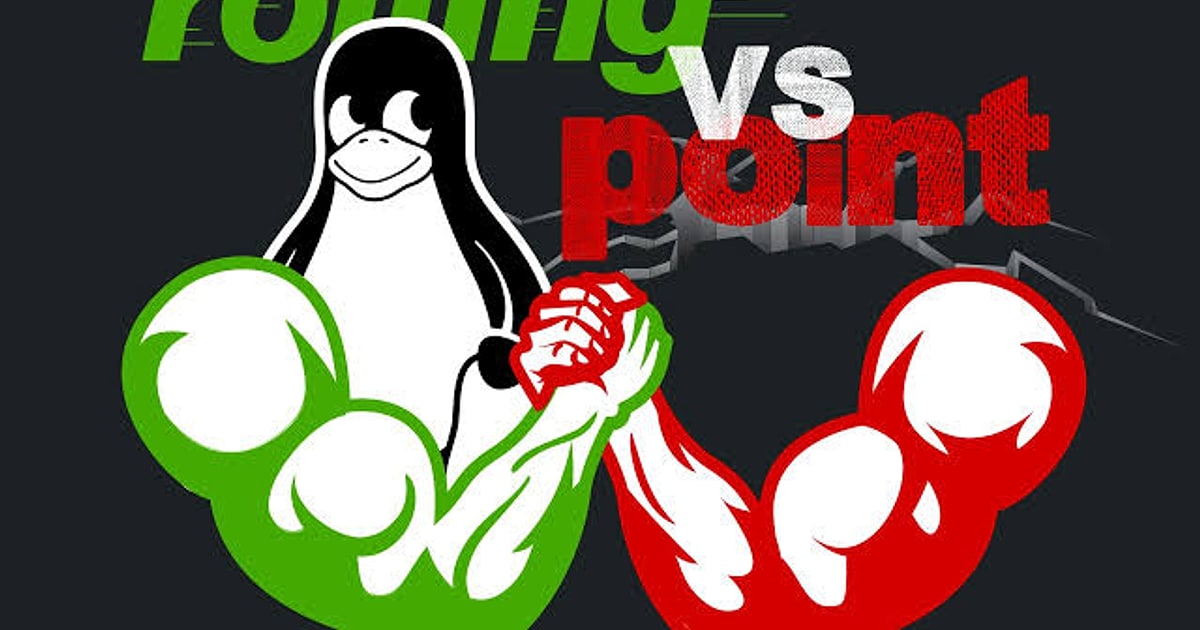
The first real decision after choosing Linux is not the desktop environment. It is the release model. Arch, Void, and openSUSE Tumbleweed move continuously. Debian, Ubuntu LTS, Fedora, and RHEL ship discrete versions with a beginning and an end.
The usual summary is "rolling gets new packages, point release gets stable ones". That is true enough to be misleading. The interesting difference is not the version number in neofetch. It is where the testing burden sits, how upgrades arrive, and what happens when something breaks.
The short version
A rolling release distro has one moving version. You install once and update forever. Packages track upstream closely, and there is no "Void 4.0" to wait for.
A point release (also called fixed or stable release) distro freezes a set of packages at a point in time. It ships security patches and bug fixes during its support window, but major application versions usually stay put until the next release.
That single design choice cascades into everything else: how often you update, how much you read release notes, how painful upgrades are, and how long your install survives.
What a rolling release actually is
In a rolling distro, the package repository is a stream rather than a snapshot. When upstream releases a new kernel, compiler, or browser, it lands in the repo after some testing, and you get it on your next update.
Examples:
- Arch Linux is the purest form. Packages are close to upstream, and users are expected to read the news before major updates.
- Void Linux is rolling but more conservative. Packages are built and tested before they reach the repo, and
xbpshandles updates transactionally. - openSUSE Tumbleweed is rolling with heavy automation: every snapshot goes through openQA, and btrfs snapshots let you roll back.
- Gentoo is rolling by source. You compile, so you control flags and timing.
- Debian sid is rolling, but it is a development branch. It is not meant for machines you depend on.
The defining property is not "bleeding edge". It is "no frozen version". A rolling distro can still hold a package back if it is broken.
What a point release actually is
A point release distro freezes its package set when the version ships. Debian 12, Ubuntu 24.04, and Fedora 42 are snapshots of a repository at a specific moment, then maintained with targeted patches.
During support, you receive:
- Security fixes, often backported to the version that shipped.
- Bug fixes that maintainers consider important.
- Occasionally a newer kernel or driver stack for hardware support, especially in Ubuntu's HWE stack.
What you usually do not receive is a new major version of an application, unless the distro explicitly allows it. That is the trade: predictability in exchange for freshness.
The difference is not new versus old
Here is the part that trips people up. A point release distro with an old version number is not necessarily insecure. Debian's security team backports patches to the version in stable. Your nginx 1.22 may carry fixes that upstream shipped in 1.27, without changing the version string.
This is called backporting: take the fix, apply it to the older codebase, test it, ship it. It is more work for maintainers and it avoids dragging in unrelated changes that could break things.
Conversely, a rolling distro is not automatically secure either. It gets upstream fixes quickly, but only if you actually update. A rolling install that has not been updated for six months is both stale and fragile, because the next update is a cliff.
So the real difference is:
| Question | Rolling | Point release |
|---|---|---|
| Who tests the combination? | Maintainers test packages, users test their own setup | Maintainers test the frozen combination before release |
| When do breaking changes arrive? | Continuously, in small pieces | Mostly at release upgrade time |
| How much do you need to read? | Release notes regularly | Release notes at upgrade time |
| What is the failure mode? | One update breaks one thing | One big upgrade breaks many things |
Side by side
| Aspect | Rolling | Point release |
|---|---|---|
| Version identity | Continuous, no marketing number | Numbered releases |
| Package freshness | Close to upstream | Frozen at release |
| Update size | Small and frequent | Small patches, then one big upgrade |
| Reinstall needed | No | Often, when jumping major versions |
| Upgrade risk | Spread across many small updates | Concentrated in one event |
| Support window | As long as the project lives | Defined end-of-life date |
| Typical users | Enthusiasts, developers, new hardware | Servers, offices, managed fleets |
| Examples | Arch, Void, Tumbleweed, Gentoo | Debian, Ubuntu LTS, Fedora, RHEL, Alpine |
What rolling release costs you
Rolling is not free. The price is attention.
Partial upgrades are dangerous. In Arch and Void, updating one package without updating the rest can leave libraries mismatched. Always update the whole system.
Configuration churn is real. A package may change its default config path, drop an option, or require a migration step. If you update once a month, you read one page of notes. If you update once a year, you read fifty.
You become part of the QA. Maintainers test that packages build and pass basic checks. They cannot test your GPU, your printer, your weird USB audio interface, and your combination of 40 AUR packages.
You need a rollback plan. A snapshot before a big update turns a broken system into a five-minute inconvenience. Without one, it turns into an evening.
What point release costs you
Software gets old. Not just desktop apps. Compilers, language runtimes, and database versions can lag by years. Sometimes that is fine. Sometimes a library you need requires a newer version than the distro ships.
Upgrades are cliffs. Everything that changed over two or three years arrives at once. Configuration formats, init systems, PHP versions, PostgreSQL majors. A point release upgrade is usually smooth, but when it is not, it is memorable.
End of life is a deadline. When support ends, patches stop. Staying is a choice with consequences, and "it still works" is not the same as "it is still maintained".
You may need third-party repositories. Newer kernels, drivers, or language runtimes often come from backports, PPAs, or vendor repos. Each one is another source of trust and another thing that can break.
The in-between models
Real distros rarely sit at the extremes.
- openSUSE Tumbleweed is rolling, but every snapshot is tested by openQA and you can roll back with snapper.
- Manjaro is rolling with curation. Packages from Arch are held for a while and tested together.
- Fedora is a point release with a short cycle. It is stable enough to use daily, and new enough that packages are rarely ancient.
- Ubuntu splits the difference: LTS every two years with five years of support, interim releases every six months with nine months of support.
- NixOS has stable channels and an unstable channel. Because every change creates a new generation, you can roll back the entire system.
- Debian testing and sid are rolling development branches that eventually become the next stable release.
Myths worth dropping
"Rolling means unstable." Stability comes from process, not from the release model. Void and Tumbleweed are careful. A badly maintained point release can be worse.
"Point release means no updates." It means no major version jumps. Security patches still arrive, often faster than people expect.
"Rolling means you never reinstall." You never reinstall to upgrade. You may still reinstall because you broke something, which is a different problem.
"Point release is more secure." It depends on backport speed. Rolling gets upstream fixes earlier. Point releases depend on maintainers porting them, which is usually fast for critical issues and slower for everything else.
How to choose
Start from the machine, not the distro.
| Situation | Better fit |
|---|---|
| Server you rarely touch | Debian stable, Ubuntu LTS, RHEL |
| Laptop with new hardware | Rolling, or Fedora |
| Work machine that must not change | Point release with a planned upgrade window |
| Learning Linux deeply | Arch or Gentoo |
| Containers | Alpine or distroless |
| You enjoy tinkering | Rolling |
| You want to forget the OS exists | Point release |
Two questions usually settle it:
- How much time per month are you willing to spend on maintenance? Rolling needs a little, often. Point release needs almost none, then a lot at upgrade time.
- What breaks if the machine is down for a day? If the answer is "nothing", rolling is fine. If the answer is "my income", choose a point release and schedule upgrades.
If you pick rolling
- Update regularly. Weekly is a good rhythm. Monthly is acceptable. Yearly is not.
- Read the release notes before big updates, especially on Arch.
- Take a snapshot first if your filesystem supports it.
- Never do partial upgrades.
- Keep a live USB nearby. Not because rolling is fragile, but because every system eventually needs one.
- Pin only what you must, and remember what you pinned.
If you pick point release
- Plan the upgrade. Read the release notes, back up, and pick a quiet day.
- Do not skip too many versions. Some distros support direct jumps, others do not.
- Know the end-of-life date and put it in your calendar.
- Prefer official backports over random third-party repos.
- Test the upgrade on a VM or a spare machine if the system matters.
Closing
Rolling and point release are two answers to the same question: when do you want to absorb change?
Rolling spreads it into small, frequent doses. Point release concentrates it into planned events. Neither is more professional, and neither is more "real Linux". They just move the work to a different place.
Pick the one whose failure mode you can live with, then maintain it accordingly.